
Two Ways to Be Paid: Choosing a Settlement Plan for a Modest Rig
Hashrate decides how much you earn; the settlement plan decides when and how evenly it lands. A 128 TH/s rig produces 4.67 USD a day net of the listed fee under either scheme, but PPS+ pays that in hourly slices while PPLNS pays after blocks confirm. For a small operator, the timing difference is often worth more attention than the headline rate.

Key takeaways
- 128 TH/s yields 0.00005742 BTC a day, worth 4.86 USD gross and 4.67 USD net at $84,692.
- PPS+ settles the block-reward part hourly at a listed 4% and the fee part at a listed 2%.
- PPLNS charges a listed 2% on both streams combined and pays after six confirmations.
- Switch schemes when your cash rhythm changes, not after one disappointing week.
Same machine, two payment shapes
Under PPS+ the block-reward component is converted into a steady hourly credit against current difficulty. The pool takes the variance, and the miner pays a listed 4% on that component for the privilege. Under PPLNS the miner takes the variance: no payment until a block is found and confirmed six times, then a share based on the last five difficulty rounds, with a listed 2% on the combined block-reward and transaction-fee total.
The expected long-run total under PPLNS is generally higher because the fee is lower and the miner keeps the upside of a lucky stretch. The word to stress is long-run. A month is not a long run, and a small rig's share of a block is tiny, so the timing of the payments can look erratic even when the underlying average is fine.
There is also a bookkeeping difference. PPS+ produces a long series of small entries that are easy to total and easy to reconcile against a bank statement. PPLNS produces a shorter series of larger entries, each tied to a block. For anyone doing their own accounts, the first is less work; for anyone matching payments to a block explorer, the second is more transparent.
What hourly settlement does to a 128 TH/s credit
Hourly settlement produces a number small enough to check. At 128 TH/s the daily output is 0.00005742 BTC, so an hour is 0.00000239 BTC. That is a useful unit: a miner can look at the statement after a day and see twenty-four entries, or look after an afternoon and see whether the count matches the hours the machine actually ran.
PPLNS has no equivalent check. The first payment may arrive within a day or may take several, depending on the pool's block rhythm and the confirmation window. A new miner watching an empty statement cannot tell a normal wait from a misconfigured worker name. That ambiguity is the strongest practical argument for starting on PPS+ and moving later, once the account is known to be correct.
The numbers before the scheme
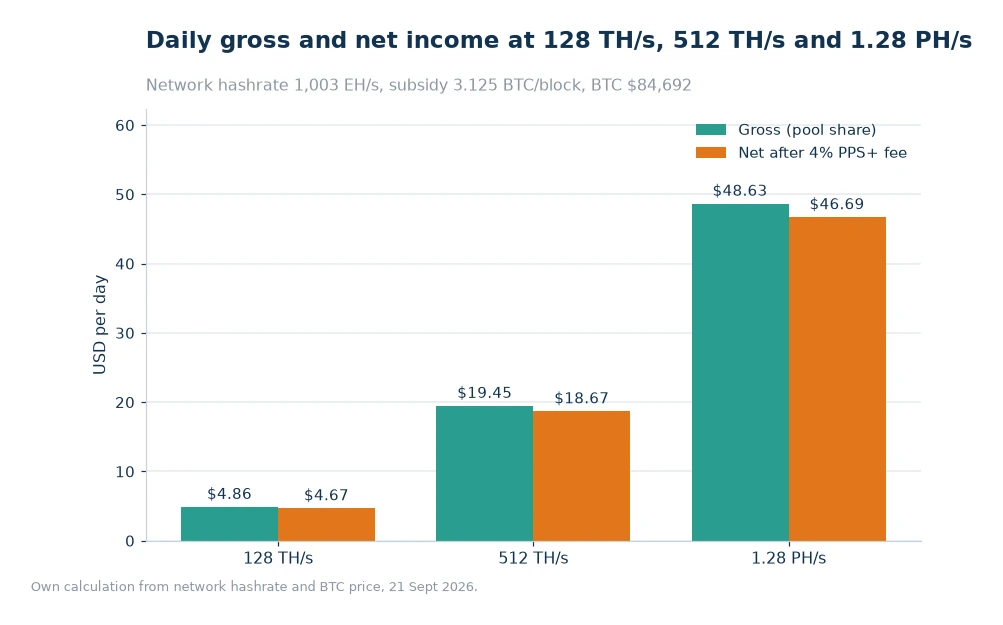
Because the differences sit in timing and variance rather than in the headline output, the table keeps the hashrate as the variable and shows the fee gap in dollars. It applies the listed 4% as a stand-in for the full PPS+ treatment of the block-reward stream.
| Hashrate | Gross per day | Net per day | Fee per day |
|---|---|---|---|
| 128 TH/s | $4.86 | $4.67 | $0.19 |
| 512 TH/s | $19.45 | $18.67 | $0.78 |
| 1.28 PH/s | $48.63 | $46.69 | $1.94 |
The fee column looks trivial at the small end and that is precisely the trap. Nineteen cents a day is 5.70 USD a month, which is real money on a rig whose power bill might be 100 USD. The percentage is the same at every tier; only the absolute amount scales.
Worked example
Build the 128 TH/s row and then express it in the units each scheme uses.
- Divide 450 BTC by 1,003,000,000 TH/s and a single terahash is worth 0.00000044865 BTC daily.
- Multiply by 128 for 0.00005742 BTC.
- Priced at 84,692 dollars, that is 4.86.
- Leave 96% after the 4% listed on the block-reward stream: 4.67.
- Under PPS+ the hourly credit is 0.00005742 ÷ 24 = 0.00000239 BTC.
- PPLNS delivers the same daily output, but in block-sized payments after six confirmations rather than twenty-four slices.
- Two percentage points on the same stream would be 0.00005742 × 0.02 × 84,692 = 0.097 dollars a day, roughly 2.92 a month.
Which fee applies to which stream
The most common misunderstanding about PPS+ is that the two rates add up to a single deduction. They do not. The 4% applies to the block-reward component, which is the 3.125 BTC subsidy per block. The 2% applies to the transaction-fee component, which is a separate and smaller stream that varies with network activity. Treating the pair as a flat six percent overstates the cost and, worse, makes the PPLNS comparison meaningless.
Under PPLNS the two streams are combined and a single listed 2% applies. On a quiet day for fees the difference between the schemes is close to the two-point gap on the subsidy. On a busy day the fee stream is larger and the PPLNS treatment of it becomes more valuable. The fee schedule is worth reading once in full rather than skimming the headline numbers. On ViaBTC Bitcoin Mining the two rates appear on separate lines precisely because they touch different streams.
Switch when the reason changes
A miner on PPS+ should move to PPLNS for a reason: the power bill is comfortably covered by other income, the coin position is being accumulated rather than spent, and the operator can tolerate a payment that arrives after a block instead of after an hour. A miner on PPLNS should move to PPS+ for the mirror reason: a fixed cost is due every month and the variance has become a cash-flow problem rather than an interesting statistic.
What should not trigger a switch is a single thin week. PPLNS payments cluster by design, so a quiet stretch is information about the pool's block rhythm, not about the scheme's quality. Change the plan at the start of a month, after a full cycle, and keep a note of why. The pool state page gives the context to judge whether a slow patch was the pool or the network.
Give a new scheme at least one full difficulty window before judging it. Difficulty windows are where the payout maths actually lives, and a switch in the middle of one compares two incomplete samples. Note the date of the change, the pool's hashrate that day and the first payment date after it; those three lines settle most later arguments about whether the move helped.
Frequently asked questions
Is PPLNS always better than PPS+?
No. PPLNS has a lower listed rate and keeps the upside of lucky blocks, but it pays only after six confirmations and its timing varies, which suits an operator who can wait and not one with a fixed monthly bill.
How much does 128 TH/s earn per hour on PPS+?
About 0.00000239 BTC, since the daily output of 0.00005742 BTC is settled across twenty-four hourly credits against current difficulty.
Do the 4% and 2% rates on PPS+ add up to 6%?
They apply to different streams: 4% to the block-reward component and 2% to the transaction-fee component, so the effective deduction depends on how large the fee stream is on the day.
Pick the scheme that matches your cash rhythm
Write down what the next twelve months of costs look like and how much notice each one gives. A miner with a monthly power bill and no other income wants the hourly certainty of the default scheme. A miner with reserves and a long horizon can accept the block-driven rhythm of PPLNS and keep the two points. Neither choice is permanent, and neither changes the hashrate on the label.
Sources: ViaBTC's home and pricing pages for settlement timing and the rates listed on each stream[1]. Readings from 21 Sept 2026: network hashrate 1,003 EH/s, difficulty 132.76 T, 3.125 BTC per block, 144 blocks a day, $84,692 per BTC. Source figures read 21 Sept 2026, published 24 Oct 2026. Totals assume continuous uptime and omit transaction-fee income.